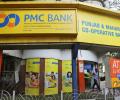
Mired in corruption, politics and with a history of suicides by its hapless depositors, PMC Bank's revival is a challenge very different from Yes Bank and LVB, both for the regulator and the rescuer, observes Tamal Bandyopadhyay.

The current sub-prime crisis, in the medium-to-long term period, will accelerate global sourcing adoption as financial institutions are exercising the option to cut costs. The institute predicts that outsourcing from the financial services sector have the potential to increase 40-45 times the current market size over the next five years, with key drivers of growth coming from cost pressures and the timely advent of more vertical-specific offerings by offshore suppliers.

'We are all in a tizzy about NBFCs in the aftermath of the IL&FS default.' 'We tend to jump to the notion that an NBFC is like a bank. But banks make a promise that deposits are liquid and have an assured return.' 'NBFCs make no such promises,' points out Ajay Shah.

Arvind Subramanian was appointed CEA in October 2014 and got a year's extension in September 2017

Coming Wednesday, Finance Minister (FM) Nirmala Sitharaman will present the 2023 Union Budget - the last full Budget ahead of the 2024 Lok Sabha elections. While India exited 2022 as a relatively bright spot in the global economy, the FM will endeavour to present a Budget that insulates India's economy against global headwinds and recession in advanced economies, while sticking to the path of fiscal consolidation. In this, she is being helped by her core team of trusted advisors.

Indian society may be more advanced than we think it is, notes Ajit Balakrishnan.

The Reserve Bank on Thursday said it is considering the possibility of allowing Islamic financial institutions to function as NBFCs since Islamic banks are not permitted under the present laws.

In India, it is not easy to fight it out with the large banks which are nimble-footed and technology-savvy and are continuously innovating on the retail turf with newer products for customer acquisition.

Tata Group-owned Air India has informed the Centre that aircraft lessors wish to set up their special purpose vehicles (SPVs) outside India since they aren't enthused about the Indian 'legal structure' and are loath to take risks. Indian airlines have a combined fleet of about 700 planes; over 85 per cent are on lease. A majority of lessors are based in Ireland due to its attractive tax policy, light-touch regulations, and swift legal system.

About 150 years ago, in British India, big farmers in the western region of Maharashtra agitated over unfair lending practices and demanded a more fair and inclusive financing structure. People say this is where the seeds of the cooperative movement, now omnipresent in the country, were sown. Today, more than 800,000 cooperative societies thrive in India, with 300 million members, a number close to the population of the United States. Despite a reach this deep--grass roots as they call it--cooperatives do not occupy a lion's share in the Indian economy.

From the Sensex pack, Power Grid, Infosys, Asian Paints, Mahindra & Mahindra, HCL Technologies, IndusInd Bank, Tech Mahindra, Bajaj Finance, Wipro, Tata Consultancy Services, HDFC Bank and Titan were the major gainers. Tata Steel and Bharti Airtel were the laggards.

Banks operating in India reported fraud of Rs 4.92 trillion as on March 31, 2021, which represents nearly 4.5 per cent of the total bank credit, showed Reserve Bank of India (RBI) data, which was sought under the Right to Information (RTI) Act by Saurabh Pandhare. The data showed 90 banks and financial institutions reported a total of 45,613 cases of loan fraud till March 31, 2021. State Bank of India - the country's largest lender - reported the highest amount of loans as fraud - Rs 78,072 crore as on March 31, 2021.

Tension between the government, specially the finance ministry, and RBI is as old as the central bank itself.

Kotak Bank was the top loser in the Sensex pack, shedding over 2 per cent, followed by ICICI Bank, PowerGrid, HDFC, IndusInd Bank and Axis Bank. NSE Nifty declined 45.75 points to 16,568.85.

We must stop stigmatising business failures. Particularly when startups are mushrooming all around, the financial system, backed by the RBI and the government, can explore ways of extending support to restart the journey of a failed entrepreneur by finance as well as counselling, recommends Tamal Bandyopadhyay.

The market capitalisation of BSE-listed firms jumped to an all-time high of Rs 304.53 lakh crore on Wednesday, buoyed by an unprecedented rally in equities where the BSE benchmark Sensex ended over the 67,000-mark for the first time ever. Rallying for the fifth day running, the 30-share BSE Sensex climbed 302.30 points, or 0.45 per cent, to end at its lifetime closing high of 67,097.44 points. During the day, it jumped 376.24 points, or 0.56 per cent, to reach its all-time intra-day peak of 67,171.38 points.

Moody's has revised to positive the outlook on the long- term ratings of private sector lenders

A whirlwind trip of the dark underbelly of global finance, covering everything from tax law changes to aiding criminals to decamp with money from bank accounts.

Stocks of public sector undertakings (PSUs) have been on fire in the past year as investors cheered an improvement in key operating metrics and embraced counters of these state-owned enterprises, analysts suggest. The S&P BSE PSU Index has gained over 90 per cent in the past year, rising much higher than the S&P BSE Sensex, which has rose nearly 19 per cent during this period, according to ACE Equity data. The BSE PSU Index, reports show, has delivered a compound annual growth rate (CAGR) of 28 per cent (including dividends reinvestments) over five years and risen by almost 60 per cent in the past year.

The RBI was not party to the decision to demonetize 500 and 1,000-rupee notes, which was taken at the highest level of India's political leadership.

'Public sector banks are like an extended arm of the government.' 'They rush to rescue certain sectors or they rush to invest in certain sectors to prop up the economy which the private banks don't.'

Finance Commission has got new team who are committed to growth initiatives.

It is also considering to hike FDI cap for public sector from 20 per cent to 49 per cent

Among the Sensex firms, Axis Bank, Power Grid, Maruti, State Bank of India, Tata Motors, ITC, Nestle and Mahindra & Mahindra were the major gainers. Bajaj Finance and Larsen & Toubro were the laggards.
To signify its revamped and enlarged role in the field of education in the banking and financial sectors, the 75-year old Indian Institute of Bankers would be known as Indian Institute of Banking and Finance, a senior official said on Friday.

We asked colleagues, present and past, to reflect on a man who has made such a difference to their lives and careers. Here it is then, a rich collection of memories that offer enchanting glimpses of the enigmatic Ajit Balakrishnan.

Severe skilled, unskilled shortage threatens to pull emergency brakes on India's industrial engine.

Nestle, Infosys, ICICI Bank, Tata Motors, Tata Consultancy Services, HCL Technologies, Tech Mahindra and Axis Bank were the other major winners. Sun Pharma, Asian Paints, Bajaj Finance and Titan were the laggards.

'The finance ministry and public sector banks have tried to keep the names of wilful defaulters secret.' 'Secrecy and concealing information are inbred among banks and even the RBI,' observes Debashis Basu, editor, www.moneylife.in.

Equity indices failed to hold on to their gains in see-saw trade on Tuesday, ending in the red for the third straight session despite a tentative recovery in global equities. The rupee too bounced back from historic lows, but the overall sentiment remained risk-averse amid concerns over economic recovery in a high interest rate scenario. The 30-share BSE Sensex had a choppy start but gained momentum in mid-session trade. However, it succumbed to selling pressure towards the fag end to close 105.82 points or 0.19 per cent lower at 54,364.85. On similar lines, the broader NSE Nifty declined 61.80 points or 0.38 per cent to finish at 16,240.05.
From the Sensex pack, NTPC, Bajaj Finance, IndusInd Bank, UltraTech Cement, Bajaj Finserv, State Bank of India, Tata Motors, ITC, Power Grid and Larsen & Toubro were the biggest gainers. IndusInd Bank climbed 2 per cent after the company on Tuesday reported a 30 per cent jump in consolidated net profit in April-June quarter at Rs 2,124.50 crore, helped by core income growth and lower bad loan provisions.

The Indian regulatory framework forced Citi to hibernate -- contrary to the claim that it never sleeps!

Billionaire Mukesh Ambani's Reliance Industries Ltd is the most valuable private company in the country, as per Hurun India's 2022 Burgundy Private Hurun India 500 list. The list, which was released on Tuesday, stated that with a value of Rs 16.4 lakh crore, Reliance is India's most valuable company, followed by Tata Consultancy Services (TCS) with Rs 11.8 lakh crore and HDFC Bank with Rs 9.4 lakh crore. Reliance is also the highest taxpayer with a payout of Rs 16,297 crore and the most profitable company with a bottomline of Rs 67,845 crore in 2022-23.

The bank will have around 501 branches.
In advanced economies where the financial system is more matured, the form of shadow banking is more of risk transformation through securitisation.

Equity benchmark indices ended flat on Wednesday with Sensex sliding 33 points and Nifty gaining 9 points after an unabated record-breaking rally in the last few trading sessions. Weak global market trends and fall in HDFC twins also spoiled markets party. The 30-share BSE Sensex dipped 33.01 points or 0.05 per cent to settle at 65,446.04.

From the Sensex pack, Infosys jumped the most by 3.67 per cent. Asian Paints, HCL Technologies, Reliance Industries, ICICI Bank, Wipro, NTPC, Tech Mahindra, Bajaj Finserv and Larsen & Toubro were among the other major gainers. State Bank of India, Bajaj Finance, Titan, Tata Steel, Tata Motors and UltraTech Cement were among the laggards.

Indian start-ups raised issues, such as blockages in international wire transfers, disruptions due to threshold limits on withdrawals, lack of communication from US agencies, and the need for preferential access to credit, in a meeting with the government over the fallout of Silicon Valley Bank's collapse. Rajeev Chandrasekhar, minister of state for electronics and information technology, held a virtual meeting with over 450 members from start-ups, venture capitalists, and investors who have been directly affected by the closure of SVB. He assured them that the IT ministry would put together a list of suggestions and give it to the finance minister on behalf of start-ups.

'A key reason for the strong interest in IPOs has been an increased focus on profitability and reasonable pricing of deals.'

Wall Street-correlated stock markets are facing the risk of correction, as Christopher Wood, the global head of equity strategy at Jefferies, conveys to investors in his latest edition of GREED & fear. Rising crude oil prices, which are nearing $100 a barrel (Brent), pose a threat to the global central bank's battle against inflation and have led to a re-evaluation of its exposure to Indian stocks. "The potential for more US Federal Reserve (Fed) rate hikes, combined with the risk that monetary tightening finally bites as regards the economy, remains a risk for Wall Street-correlated world stock markets. "There is also the oil factor. This is why GREED & fear continues to believe the pain trade is down. "Areas in Asia, such as Indian midcaps, which have already done very well, are at obvious risk of some profit-taking," writes Wood.
 © 2026 Rediff.com - Advertise with us - Disclaimer - Privacy Policy - Sitemap - Feedback - About us - Terms of use - Grievances